Syncrra ERP: Control Manufacturing From Gate Entry to Billing in Real Time
Discover how Syncrra unifies manufacturing execution from gate entry to billing using real-time workflows, built-in intelligence, and audit-ready traceability.

Author
Prachi Bhalerao
Published
Feb 15, 2026
Last updated
Feb 27, 2026
Manufacturing success today depends on how smoothly operations flow from start to finish. Fragmented systems, delayed handovers, and manual coordination create friction that modern manufacturers can no longer afford.
Why Manufacturing Needs True End-to-End Control Today
Manufacturing operations rarely fail because of a single issue. Most breakdowns happen in the gaps between stages. Materials arrive at the gate but are not logged accurately. Inventory exists but is not visible to production teams. Quality checks happen after delays have already occurred. Dispatch is ready, but billing cannot proceed because execution data is incomplete.
For years, manufacturers have tried to manage this complexity using multiple disconnected systems. Gate entry may be tracked in one tool, production in another, quality in spreadsheets, and billing in a finance system. While each system works independently, the lack of continuity between them creates blind spots, delays, and unnecessary manual effort.
In 2026, this fragmented approach is no longer sustainable. Manufacturing environments are faster, more regulated, and more cost-sensitive than ever. Customers expect accurate delivery commitments, regulators demand traceability, and leadership teams need real-time visibility across operations.
This is where Syncrra’s end-to-end manufacturing ERP changes the equation. By connecting operations from gate entry to billing within a single execution platform, Syncrra removes handover gaps and enables manufacturing teams to operate with clarity, speed, and control.
What “Gate Entry to Billing” Means in Syncrra
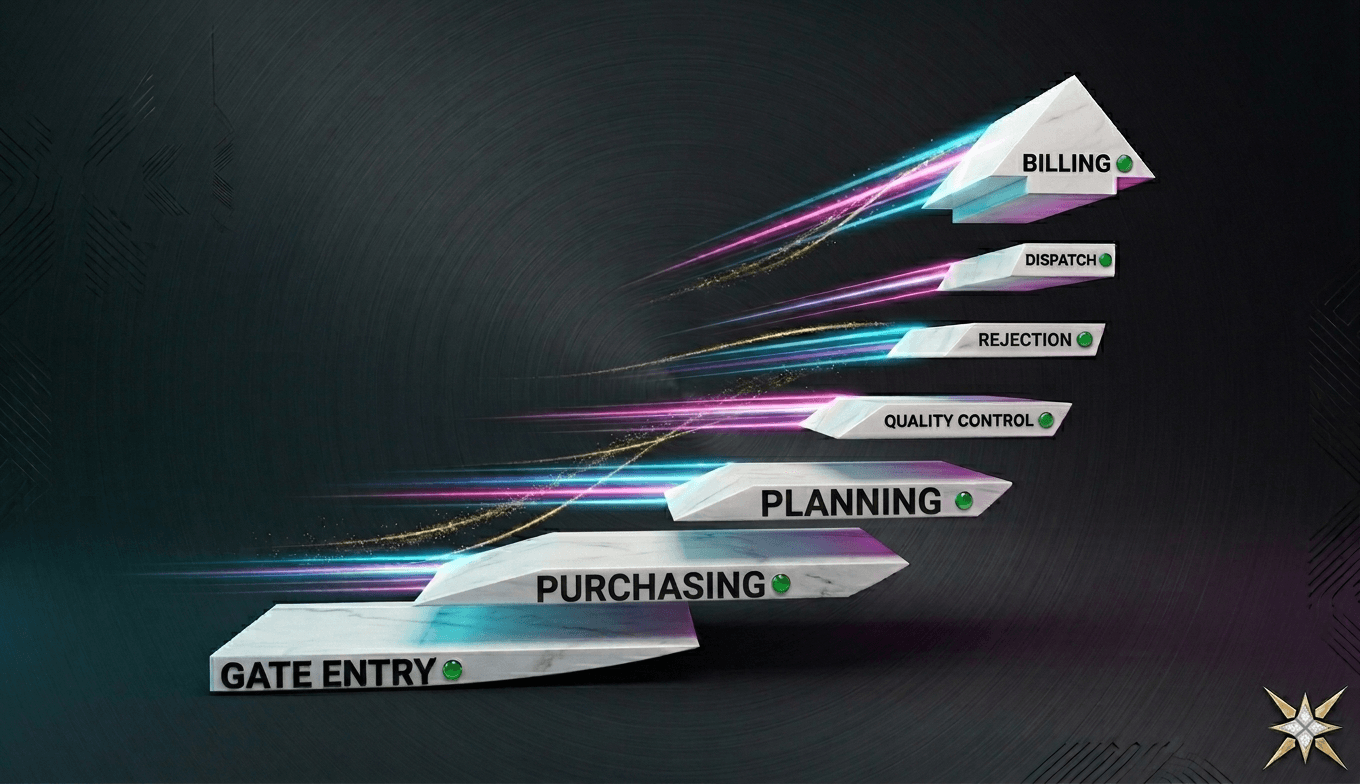
Gate entry to billing is not just a concept in Syncrra. It represents a fully connected operational lifecycle where every stage of manufacturing execution is linked, traceable, and workflow-driven.
In a Syncrra-powered manufacturing environment, this lifecycle includes:
- Material gate entry and inward tracking
- Inventory validation and storage allocation
- Production planning and job execution
- Quality inspections and approvals
- Dispatch readiness and logistics confirmation
- Billing triggered directly from execution data
Each stage flows seamlessly into the next. There is no dependency on manual reconciliation, email-based coordination, or duplicate data entry. Execution data moves automatically across teams.
According to a 2025 Gartner manufacturing study, organisations with end-to-end ERP execution visibility report up to 35 percent fewer operational delays compared to those using fragmented systems. Syncrra delivers this benefit by ensuring that execution data is connected, reliable, and available in real time.
Why Fragmented Manufacturing Systems Create Hidden Risk
Disconnected systems create risk because they rely heavily on people to bridge gaps. Teams spend time checking status, chasing approvals, and reconciling information across tools. As operations scale, this dependence becomes unsustainable.
Common risks created by fragmented systems include:
- Inventory mismatches between stores and production
- Delayed quality approvals holding up dispatch
- Incomplete execution data blocking billing
- Audit gaps caused by missing traceability
- Overdependence on a few experienced individuals
These risks often remain invisible until they cause serious disruption. By the time leadership becomes aware, recovery is costly and slow.
Syncrra eliminates these risks by acting as a single execution layer across manufacturing operations. Every movement, approval, and status change is captured automatically, creating a strong and reliable operational backbone.
How Syncrra Connects Execution Across Manufacturing Stages
Syncrra is built as a workflow-driven manufacturing ERP, not a collection of isolated modules. Instead of treating gate entry, production, quality, and dispatch as separate systems, Syncrra connects them as steps in a single execution flow.
When material enters the gate, Syncrra captures it as the starting point of execution. Inventory availability immediately reflects in production planning. Production progress automatically updates quality workflows. Once quality is approved, dispatch and billing move forward without manual intervention.
This connected execution ensures that:
- Production does not start without validated inventory
- Quality issues are caught before dispatch
- Billing reflects actual execution, not assumptions
- Leadership has real-time visibility into progress
Syncrra does not just record activity. It orchestrates execution across the manufacturing lifecycle.
Workflow-Driven Execution Reduces Delays and Errors
Manual coordination is one of the biggest causes of delay in manufacturing. Emails, calls, and follow-ups slow work down and introduce errors. Syncrra replaces this with workflow-driven execution.
Examples of workflow automation in Syncrra include:
- Inventory approval triggering production readiness
- Production completion triggering quality checks
- Quality clearance enabling dispatch
- Dispatch confirmation triggering billing
According to IDC, manufacturers using workflow-driven ERP systems see a 30 percent reduction in manual coordination effort. Syncrra delivers this by ensuring work progresses automatically, with clear ownership and full visibility at every stage.
Real-Time Visibility Across the Entire Manufacturing Lifecycle
End-to-end control is impossible without real-time visibility. Syncrra provides live insights across gate entry, inventory, production, quality, dispatch, and billing on a single platform.
Teams no longer need to reconcile multiple reports or wait for updates. Everyone works from the same real-time operational data.
This visibility enables:
- Faster identification of bottlenecks
- Better coordination across departments
- Accurate delivery commitments
- Faster, more confident decision-making
McKinsey research shows that manufacturers with real-time operational visibility improve efficiency by up to 25 percent. Syncrra delivers this visibility without adding reporting complexity.
Traceability and Compliance Built Into Execution
Traceability is no longer optional. Audits, regulations, and customer requirements demand complete visibility into how products are made and moved.
Syncrra embeds traceability directly into execution. Every material movement, production step, quality check, approval, and dispatch action is recorded automatically.
This provides:
- End-to-end audit trails
- Clear accountability across teams
- Faster audit readiness
- Reduced compliance risk
According to Deloitte, 67 percent of manufacturing leaders rank traceability and governance as critical ERP requirements. Syncrra meets these needs without slowing operations.
Why End-to-End ERP Improves Billing Accuracy and Speed
Billing delays are often caused by missing or untrusted execution data. When finance teams rely on manual confirmation, invoicing slows down and disputes increase.
Syncrra links billing directly to execution. Once dispatch is confirmed, billing can be triggered automatically using actual production and delivery data.
This results in:
- Faster invoice generation
- Fewer billing disputes
- Improved cash flow
- Stronger alignment between operations and finance
By connecting execution and billing, Syncrra improves both operational and financial efficiency.
Traditional ERP vs Syncrra’s End-to-End Execution Model
Traditional ERP systems were designed primarily as systems of record. Their main purpose is to capture transactions at each stage of manufacturing, such as material receipt, production completion, quality approval, or invoice generation. While this ensures documentation and compliance, it does little to support how work actually moves across the factory floor.
In a traditional ERP setup, each stage operates in isolation. Information is recorded after an action is completed, and the next team often waits for manual confirmation before proceeding. This creates handover gaps where work slows down, approvals get delayed, and teams rely heavily on emails, calls, or individual follow-ups to keep operations moving.
Syncrra follows a fundamentally different approach. Instead of treating stages as separate checkpoints, it connects them into a single, continuous execution flow. When one stage is completed, the next stage is automatically triggered through defined workflows. Inventory validation flows into production readiness, production completion activates quality checks, and quality clearance moves work toward dispatch and billing without manual intervention.
This workflow-driven execution significantly reduces dependency on human coordination. Work progresses based on system logic rather than reminders or manual updates. Teams always know the current status, what comes next, and who owns the next action.
Another critical difference lies in how insight is used. Traditional ERP systems explain what happened after execution is complete. Syncrra focuses on influencing what happens next. By combining real-time visibility, workflow automation, and intelligent execution control, Syncrra helps teams anticipate issues, respond faster, and maintain operational discipline.
This shift from transaction recording to execution orchestration defines modern manufacturing ERP. It enables manufacturers to operate with greater speed, consistency, and control in increasingly complex environments.
Conclusion: Why Syncrra Sets the New Standard for Manufacturing ERP
Manufacturing success today depends on how smoothly operations flow from start to finish. Fragmented systems, delayed handovers, and manual coordination create friction that modern manufacturers can no longer afford.
Syncrra’s end-to-end manufacturing ERP removes these gaps by connecting execution from gate entry to billing within a single, intelligent platform. By combining real-time visibility, workflow-driven execution, and built-in traceability, Syncrra enables manufacturers to operate with clarity, speed, and confidence.
As manufacturing operations continue to scale in complexity, systems that merely record activity will fall behind. Platforms that orchestrate execution will lead.
Syncrra is built for that future.
Frequently Asked Questions: Syncrra End-to-End Manufacturing ERP
1. What makes Syncrra different from traditional manufacturing ERP systems?
Syncrra is execution-focused. It connects operations end to end using workflows and real-time data, rather than treating each function as a separate module.
2. Can Syncrra handle the complete manufacturing lifecycle?
Yes. Syncrra manages the entire lifecycle from gate entry and inventory to production, quality, dispatch, and billing within one connected system.
3. How does Syncrra reduce operational delays?
By automating workflows and removing manual handovers, Syncrra ensures work moves forward without waiting for follow-ups or confirmations.
4. Is Syncrra suitable for mid-sized and growing manufacturers?
Yes. Syncrra is modular and scalable, allowing manufacturers to start small and expand as operations grow.
5. Does Syncrra support real-time visibility across departments?
Yes. All teams work from the same live operational data, improving coordination and decision-making.
6. How does Syncrra improve billing accuracy?
Billing is directly linked to execution and dispatch data, reducing errors, disputes, and delays.
7. Can Syncrra support audits and compliance requirements?
Yes. Syncrra captures complete audit trails and embeds governance into daily execution.
8. Does Syncrra require heavy customisation?
No. Syncrra uses configurable workflows, reducing the need for costly custom development.
9. Can Syncrra scale across multiple plants or locations?
Yes. Syncrra is designed to support multi-plant and multi-location manufacturing environments.
10. How quickly can teams start using Syncrra?
Syncrra is designed for fast onboarding, allowing teams to start with core workflows and expand progressively.
Did you find this blog helpful? Share it with others who might benefit!
Loading link...
No previous post
Previous Blog PostWhy Manufacturing ERP Fails at Execution and How Syncrra Fixes It
Next Blog PostRelated Blogs
Why Manufacturing ERP Fails at Execution and How Syncrra Fixes It
Syncrra redefines manufacturing ERP with workflow-driven execution, real-time visibility, and Agentic AI that helps teams act faster and stay in control.
 By Shekhar Gadekar
How AI-Driven ERP Is Transforming Manufacturing Operations in 2026
Discover how AI-driven ERP systems are transforming manufacturing in 2026 with real-time visibility, workflow automation, AI-generated dashboards, and Agentic AI insights.
 By Nisha Mane
Why Traditional Manufacturing ERP Systems Fail at Scale and How Modern Platforms Fix It
Learn why traditional manufacturing ERP systems fail as operations scale and how modern, AI-driven ERP platforms enable growth with real-time visibility and automation.
 By Akash Jivane